


Why your truck is still in derate — and what to check next?
Adding DEF only addresses a low-fluid condition if the truck recognizes the refill and no other fault is present. It does not repair a failed level sensor, restore DEF pressure, correct a dosing problem, or fix an SCR performance fault. If a DEF or SCR fault already triggered an emissions-related inducement, the system may need to confirm that the underlying problem has been corrected before normal operation returns. The exact recovery procedure depends on the truck, engine, model year, fault, and installed software.
You added DEF at the truck stop. The tank is full, but the warning is still on and the truck still won't pull like it should.
Before you buy another jug, check what the dash is actually telling you.
A full DEF tank and a healthy DEF system are not the same thing. Your truck can have plenty of fluid available and still have a problem with the level signal, DEF quality monitoring, pressure, dosing, NOx sensors, SCR efficiency, or an already active inducement.
There is also no single DEF reset sequence that works on every diesel truck.
The right next step depends on what warning is active, which fault codes are present, and whether the truck is actually in an inducement or derate condition.
Start With the Warning on the Dash
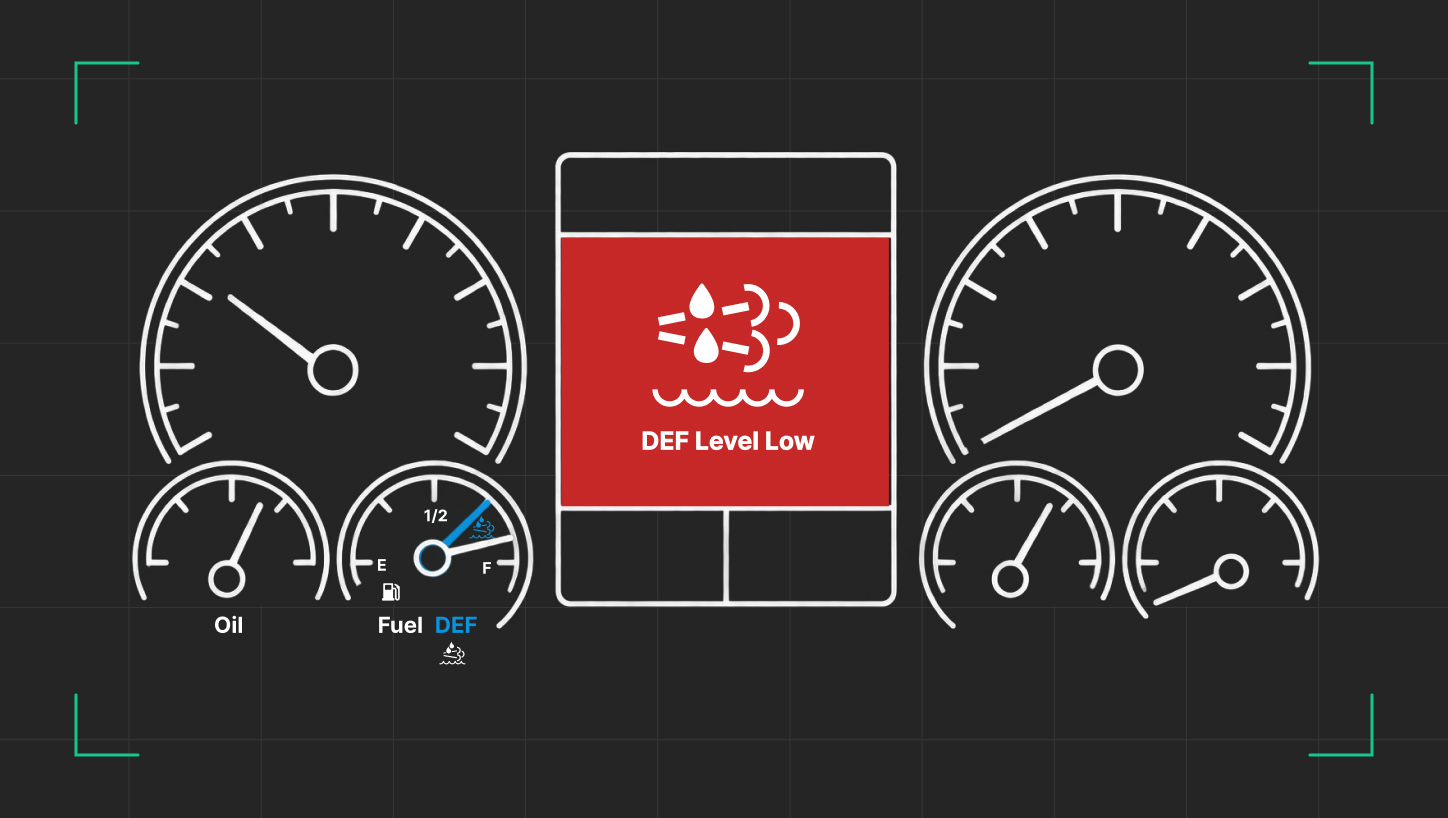
Drivers often call every DEF-related warning a “DEF light.”
The actual message matters.
A low-DEF warning, a DEF system fault, an SCR efficiency fault, and a Check Engine light do not necessarily point to the same problem. Warning combinations and derate strategies also vary by manufacturer and model year.
Start by recording:
the exact dash message;
the DEF gauge reading;
any countdown or speed restriction;
whether the warning appeared before or after the refill;
whether the truck lost power, speed, or both.
A gauge that still reads empty calls for a different first check than a normal DEF gauge combined with an SCR fault.
Low DEF Level: When a Refill Can Actually Fix It
If low DEF level was the only problem, adding the amount specified by the owner's manual may allow the warning to clear once the truck recognizes the new level and completes any required operating conditions.
Don't assume that a small splash is enough.
Some trucks require a minimum refill quantity before the system recognizes that the tank has been replenished. At the same time, don't assume you need to fill the tank to the brim.
Follow the refill instructions for that specific truck.
There is also no universal amount of time or mileage after which the light must disappear. The required recognition and recovery behavior varies by application.
DEF or SCR System Fault: A Full Tank Doesn't Fix It
A full tank only tells you that there is fluid available.
The truck may still have a problem with:
the DEF level signal;
DEF quality;
DEF pressure;
the DEF pump;
the doser;
DEF lines;
NOx sensors;
exhaust temperatures;
SCR efficiency;
another aftertreatment component.
More DEF won't repair those faults.
This is one of the most important points when a driver says, “I just filled it and the light is still on.”
If the system detected a fault that caused the inducement, the problem needs to be diagnosed before the truck can reliably return to normal operation.
Reduced Power or a Speed Limit: Is It Really a DEF Problem?
An emissions-related restriction is often called an inducement in service information.
Depending on the system, an inducement can limit torque, vehicle speed, or both.
But a truck that is down on power does not automatically have a DEF problem.
A DEF warning can appear alongside another aftertreatment or engine fault. That's why the complete fault information matters more than the lamp by itself.
Read the codes before deciding what caused the derate.
Why the DEF Gauge Still Reads Empty After Refill
There are two different possibilities here, and they should not be confused.
The Refill Has Not Been Recognized Yet
Check the owner's manual for the minimum refill quantity and any required ignition or operating procedure.
Give the display the update time specified for that truck.
Repeatedly cycling the key is not a substitute for the correct procedure.
If you've added enough DEF and the reading still doesn't change, stop topping it off. An unresponsive gauge is a reason to investigate the level signal — not keep pouring fluid into the tank.
The Level Signal Is Wrong or Missing
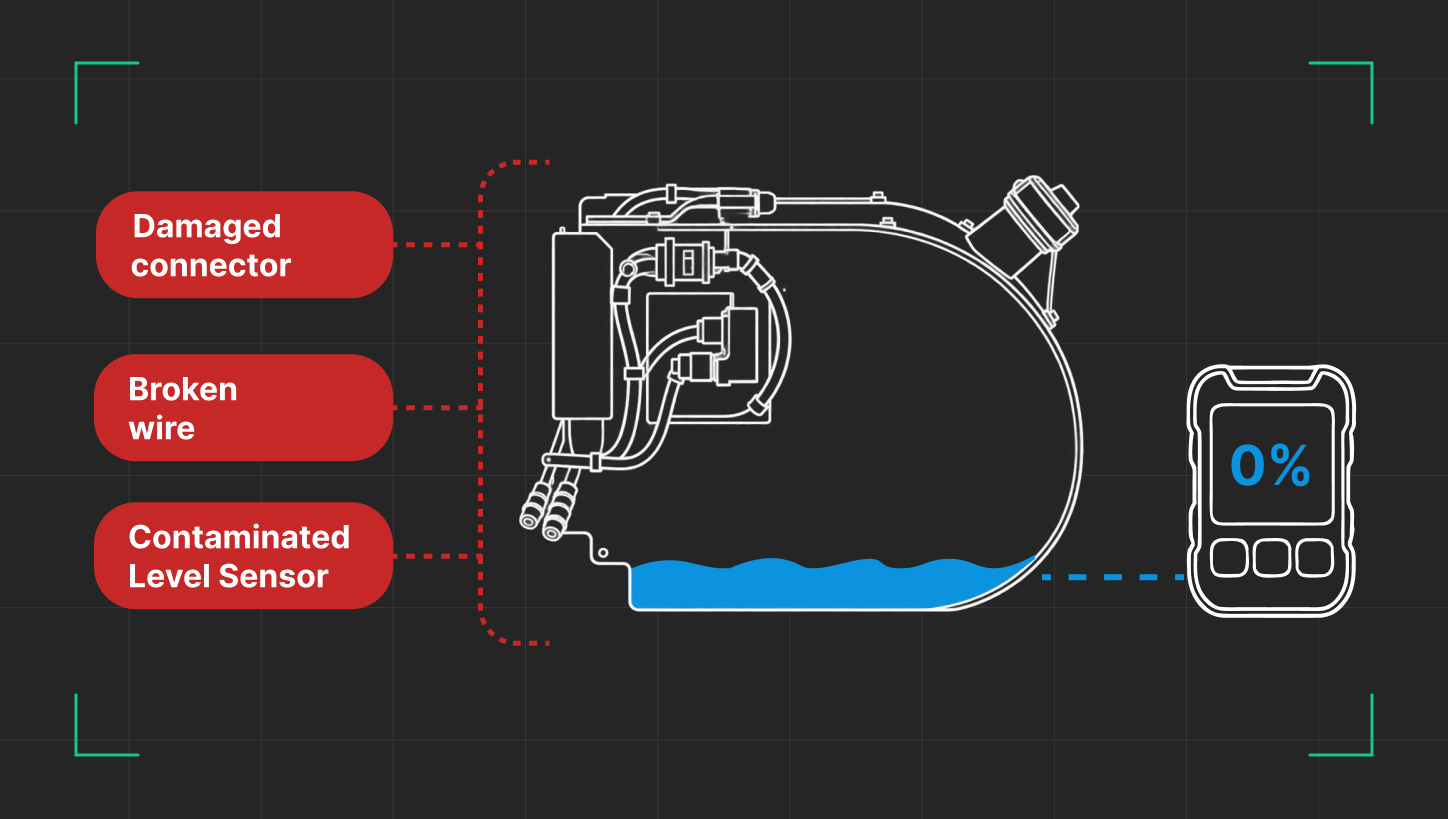
Possible causes include:
a level-sensing fault;
damaged wiring;
a poor connector connection;
a communication problem;
a problem with the DEF tank/header assembly.
Some tank assemblies combine several sensing functions, and their design and serviceability vary by application.
A technician should compare the level reported by diagnostic software with the known tank condition and follow the applicable manufacturer procedure.
Do not condemn the entire DEF tank or header from the dashboard reading alone.
Also keep the information separate:
current level reading ≠ stored fault history ≠ current inducement status.
An old inactive code does not, by itself, prove that the gauge is being held at empty or that the truck is still derated.
A DEF Quality Warning Does Not Always Mean Bad DEF
DEF used in these systems is a nominal 32.5% urea solution in purified water and should meet ISO 22241 requirements and the engine manufacturer's specifications. API certification can help identify qualifying DEF products.
Contamination, dilution, and poor storage can cause problems.
If the wrong fluid has been added to the DEF tank, don't try to dilute it by adding more fresh DEF. Follow the manufacturer's contamination procedure and have the system handled by a qualified technician.
The amount of work required can extend beyond simply draining the tank, depending on how far the contaminated fluid has traveled through the system.
But there is another important distinction:
A DEF quality warning is not automatically a laboratory result proving that the fluid is bad.
Depending on the system, DEF quality may be monitored directly or inferred through SCR performance and NOx-related data. That means a sensor or another system fault can sometimes produce a quality-related diagnosis without the DEF itself being the original problem.
EPA's March 2026 guidance specifically addresses alternative approaches to DEF quality monitoring, including NOx-based monitoring, and allows applicable software updates for existing engines under the relevant requirements.
Cold temperatures matter too. A DEF quality test that has not yet been able to run under the required conditions is not the same thing as a failed quality test.
What P207F, P204F, and SPN 3364 Actually Tell You
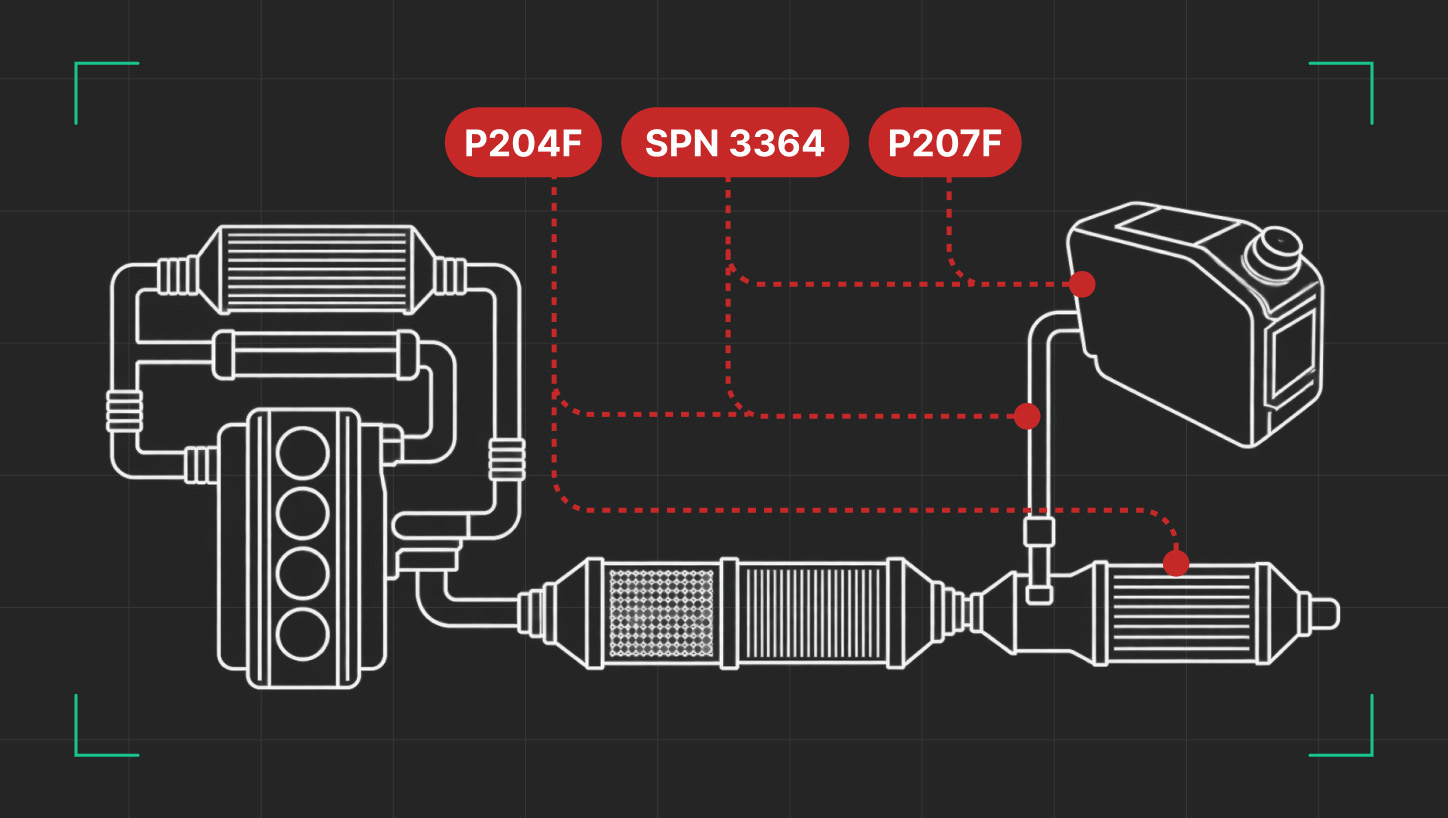
Use the code format your truck actually reports.
A generic scan tool may show P-codes, while heavy-duty diagnostic systems commonly use SPN/FMI combinations or manufacturer-specific fault numbers.
Don't assume that different code formats are interchangeable.
P207F is commonly labeled Reductant Quality Performance.
Treat that wording as a direction for diagnosis, not as proof that the DEF in the tank is contaminated.
Check:
the exact manufacturer definition;
companion fault codes;
current versus inactive status;
the applicable diagnostic test.
The same basic code can lead to different diagnostic paths depending on the engine and aftertreatment system.
P204F — Reductant System Performance
P204F is commonly labeled Reductant System Performance and may include a Bank 1 designation.
It does not identify one specific failed component.
Depending on the application, the diagnostic procedure may lead to checks of DEF supply, pressure, dosing, sensing, or other parts of the reductant system.
Don't replace a DEF pump just because P204F is present.
The test results should determine what actually needs attention.
SPN 3364 — DEF Quality
SPN 3364 identifies the Aftertreatment 1 Diesel Exhaust Fluid Quality parameter on applicable J1939 systems.
The SPN identifies the parameter. The FMI describes the reported failure mode.
Always record:
SPN;
FMI;
reporting module;
active/inactive status;
accompanying manufacturer fault number.
Then use service information for the actual engine.
A fault number copied from a different engine manufacturer's chart is a poor basis for ordering parts.
Why Clearing a Code May Not Release the Derate
Erasing fault history is not the same as correcting the fault or satisfying the conditions for recovery.
Some systems can release a restriction after the relevant condition is corrected and the required monitor passes. Others may require a specific service routine or recovery procedure.
That does not mean every refill requires a laptop reset.
It also does not mean every stored code is keeping the truck derated.
The important questions are:
What fault is currently active?
What is the current inducement status?
Has the truck completed the conditions required for recovery?
If the warning comes back after clearing the code, the problem may still be present, intermittent, or related to another fault.
Save the new fault information instead of repeatedly clearing the code and hoping for a different result.
What to Check Before Replacing Parts
A good diagnostic process is more valuable than a parts cannon.
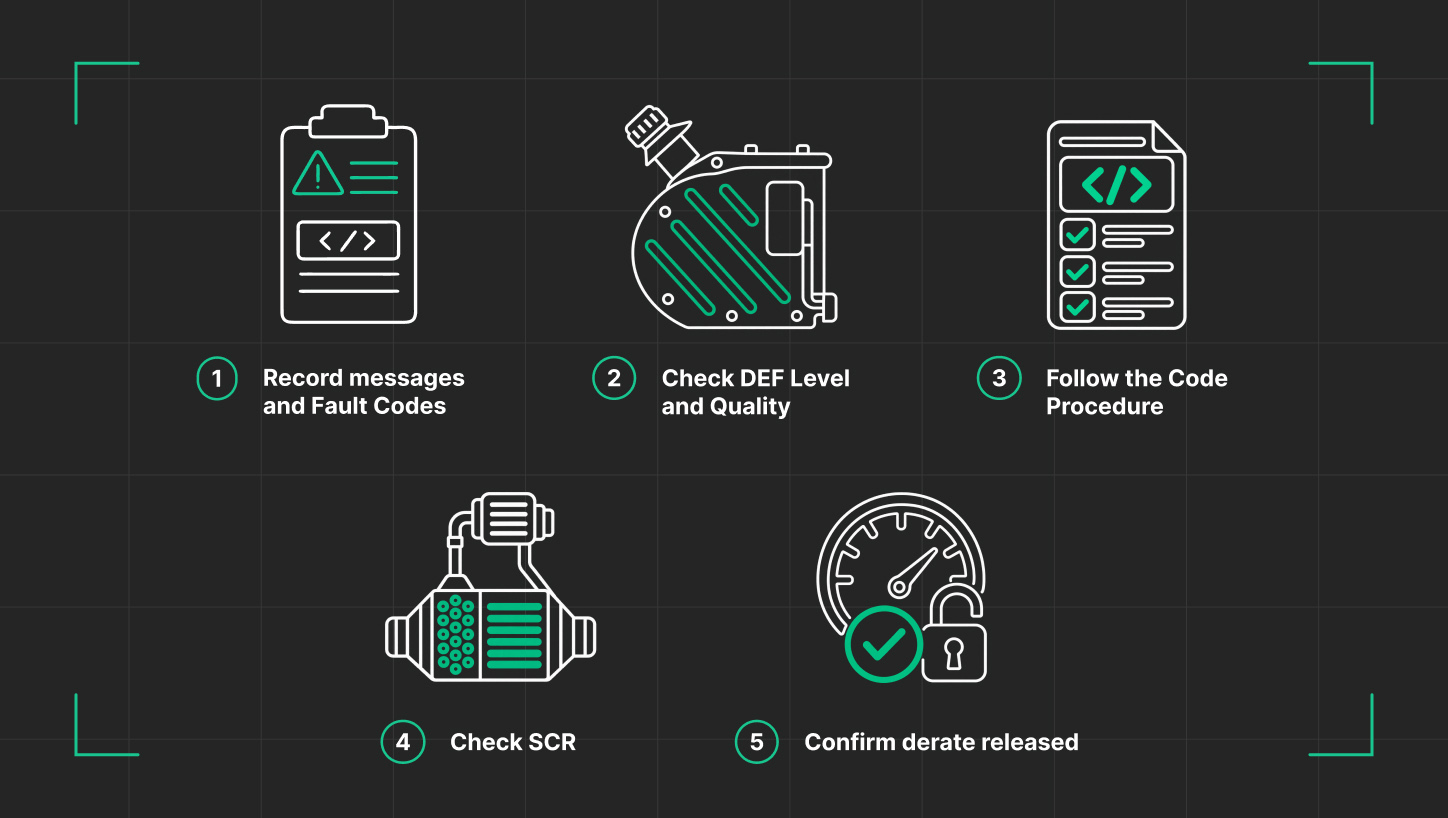
1. Record the Symptoms and Fault Information
Before clearing anything, save:
the exact dash message;
complete fault codes;
active and inactive status;
available freeze-frame or event information;
DEF level;
approximate amount of DEF added;
engine model;
model year;
current power or speed restriction.
Also note whether the warning started before or after the refill.
2. Confirm the DEF Level and Fluid Condition
Check that the refill matches an information found in owner's manual.
If the gauge remains incorrect, compare the dashboard reading with what is reported by diagnostic software.
Check the source and possible contamination of the fluid.
Use the manufacturer's specified quality test when needed. Appearance alone cannot establish that DEF meets the required specification.
3. Follow the Actual Fault Procedure
Let the codes and test results guide the work.
Depending on the problem, a technician may need to check:
wiring;
communication;
tank sensors;
DEF pressure;
pump operation;
DEF lines;
leaks;
doser delivery;
NOx sensors;
exhaust temperature sensors.
Pressure limits, dosing quantities, and pass/fail values are application-specific. A generic article cannot provide one set of numbers that is correct for every truck.
4. Check SCR Performance When the Evidence Points There
If DEF delivery checks pass but an SCR performance fault remains, follow the OEM procedure for:
NOx sensor operation;
exhaust temperature;
exhaust leaks;
SCR catalyst performance;
related engine faults;
DPF-related faults where applicable.
Don't jump straight to an SCR catalyst replacement.
5. Verify Recovery
After the underlying problem is corrected, complete the required verification and recovery procedure.
Depending on the truck, this may involve:
a service routine;
specific operating conditions;
a diagnostic test;
an applicable software update;
an inducement reset.
Confirm that the relevant fault and restriction have actually cleared.
Don't rely only on the warning lamp going out.
A Parked Regen Is Not a Universal DEF Reset
This is another area where drivers can waste time.
A DPF regeneration burns accumulated soot.
The SCR system uses DEF to reduce NOx.
Those are different jobs.
A parked regen does not repair:
a DEF level sensor;
contaminated DEF;
a damaged wire;
low DEF pressure;
a failed doser;
an SCR efficiency problem.
Some OEM diagnostic procedures may use a regeneration or another controlled operating test to create the conditions needed for evaluation.
Run it only when the applicable procedure calls for it.
Don't keep requesting parked regens just because the dash mentions DEF.
And if the truck is already under a severe speed restriction, “just drive it until the light clears” is not a universal or appropriate recovery plan.
Get safely out of traffic and arrange assistance when the truck cannot maintain a safe operating speed.
When Software Updates Can Help
Programming can be part of the repair when the installed calibration or configuration is incorrect, a module has been replaced, or an applicable OEM software update addresses the condition.
This is why software should be considered during diagnosis, not only after expensive hardware has been replaced.
A legitimate programming solution can include:
OEM software updates;
ECM/ACM reprogramming;
configuration correction;
stock programming;
restoration of the correct factory calibration;
required diagnostic or recovery procedures.
Returning a module to stock can be the correct repair when the truck has incorrect or modified software.
But stock programming is not a universal cure for a DEF warning.
A failed pump, bad level signal, contaminated DEF, faulty doser, or SCR hardware problem still needs to be addressed.
EPA Guidance and What It Means for Your Truck
There have been important changes in the EPA's approach to DEF monitoring and SCR inducement.
In August 2025, EPA issued revised SCR inducement guidance that gives manufacturers more flexibility in how applicable inducement strategies are implemented, while also allowing manufacturers to retain previously approved approaches. The guidance does not mean that every truck on the road automatically received new software or a new derate strategy.
In March 2026, EPA issued guidance allowing alternative DEF quality monitoring approaches, including NOx sensor-based strategies, with compliant software updates possible for existing engines under the applicable requirements.
EPA also published a proposal in July 2026 that would change certain inducement requirements for newly manufactured diesel engines and vehicles and is considering how related changes could apply to in-use vehicles and engines. That proposal is not the same thing as a universal change already installed on every truck.
For your truck, the practical question is much simpler:
Does the OEM have an applicable software update for this engine, model year, and current calibration?
That needs to be checked against the actual vehicle.
Programming Services: What Should Happen Next?
If you're considering programming work, have the following information ready:
engine make and model;
model year;
VIN or chassis information;
complete fault report;
current ECM/ACM configuration;
repair findings.
That allows the software recommendation to match the actual truck instead of guessing from a dashboard warning.
Remember that these are different things:
OEM software update
Stock restoration
Diagnostic reset
Configuration correction
Application-specific calibration
They should not all be described as the same “DEF delete” or “reset.”
For U.S. road trucks, programming and repairs should remain consistent with the vehicle's applicable emissions requirements. EPA's current guidance also emphasizes access to emissions-related diagnostic and repair information for independent repair.
DEF Light Still On After Refill: What Should You Do?
If the tank is full and the warning remains on, don't automatically add more DEF.
Start with the basics:
Check the exact dash message.
Read the complete fault codes.
Check whether the DEF gauge actually recognized the refill.
Determine whether the restriction is an inducement or another engine/aftertreatment problem.
Follow the manufacturer's diagnostic and recovery procedure.
Only after the actual problem is identified should you decide whether the next step is a repair, reset, stock programming, software update, or another applicable solution.
A full DEF tank is a starting point — not proof that the problem is fixed.
FAQ
Why is my DEF light still on after I filled the tank?
Because the warning may be related to more than DEF level. The truck may have a quality, sensor, dosing, pressure, SCR, or other aftertreatment fault. It may also need to complete the required recovery conditions after a low-DEF event.
How long should the DEF light take to clear after a refill?
There is no single time or mileage that applies to every truck. Follow the owner's manual for the refill and recovery procedure. If the DEF level updates but a system-fault warning remains, diagnose the fault instead of adding more fluid.
Why does my DEF gauge still show empty after I refilled it?
The refill may not have been recognized or the system may not yet have updated the displayed level. If the tank has enough DEF and the reading still doesn't change, investigate the level signal, tank/header, wiring, and related diagnostics rather than continuing to fill the tank.
Can bad DEF cause the truck to stay in derate?
Yes. Poor-quality or contaminated DEF can cause a DEF/SCR-related fault and, depending on the system, an emissions-related inducement. A quality warning doesn't always mean the fluid is bad. The sensor and SCR issues can also cause the computer to throw a quality warning.
What does P207F mean?
P207F is commonly associated with Reductant Quality Performance. It is a diagnostic direction, not automatic proof that the DEF in the tank is contaminated. The exact OEM definition and test procedure should be followed for the engine.
What does P204F mean?
P204F is commonly associated with Reductant System Performance. It does not identify one failed component, so the DEF supply, pressure, dosing, sensing, and related systems should be checked according to the applicable diagnostic procedure.
What does SPN 3364 mean?
SPN 3364 identifies the Aftertreatment 1 Diesel Exhaust Fluid Quality parameter on applicable J1939 systems. Always read it together with the FMI and reporting module to understand the specific failure mode.
Can I reset the DEF warning myself?
A simple low-level warning may resolve by following the owner's manual after the correct refill. A fault-related inducement may require diagnostic software, a prescribed service routine, or confirmation that the underlying problem has been corrected. Generic key-cycle and battery-disconnect tricks are not reliable universal procedures.
Can programming remove a DEF derate?
Programming can be part of a legitimate repair when an OEM update, stock restoration, configuration correction, or other applicable calibration is required. It is not a universal fix for a DEF warning, and software should not be used as a substitute for a failed component or contaminated fluid. For regulated road vehicles, any programming work must comply with applicable emissions requirements.