


What do P20EE and SPN 4364 FMI 18 mean, and how can they be fixed?
P20EE and SPN 4364 FMI 18 indicate that the engine control system has detected insufficient NOx conversion efficiency in the SCR (Selective Catalytic Reduction) system. The fault does not automatically mean that the SCR catalyst itself has failed. A biased NOx sensor, poor-quality DEF, incorrect DEF dosing, crystallization, exhaust leaks, temperature problems, or an actual catalyst failure can all produce the same result. The correct diagnostic approach is to verify the NOx sensors, DEF quality and dosing system, exhaust temperatures, and SCR catalyst performance before replacing expensive aftertreatment components. On applications where a software-based solution is legally permitted and appropriate, ECM/ACM programming can also be evaluated as part of the overall repair strategy.
Understanding the Difference Between P20EE and SPN 4364 FMI 18
Although P20EE and SPN 4364 FMI 18 describe a similar SCR efficiency problem, they belong to different diagnostic coding standards.
P20EE is an OBD-II diagnostic trouble code used across a range of diesel applications, including passenger vehicles, light commercial vehicles, heavy-duty trucks, and off-highway equipment equipped with SCR aftertreatment systems.
SPN 4364 FMI 18 is a fault code that follows the SAE J1939 format you’ll see on a lot of heavy-duty trucks, buses, construction equipment, farm machinery, and other commercial vehicles. The SPN 4364 part points to SCR conversion efficiency, and the FMI 18 means that value is running lower than it should be.
Both codes can identify the same underlying SCR NOx conversion-efficiency problem, although they are not universally interchangeable. Their exact definitions, monitoring strategies, diagnostic procedures, and repair recommendations may differ depending on the manufacturer, engine platform, and emissions generation.
What Is P20EE?
P20EE means the SCR system’s NOx catalyst on Bank 1 isn’t doing its job well enough — the computer’s calculated conversion efficiency has dropped below the minimum it allows.
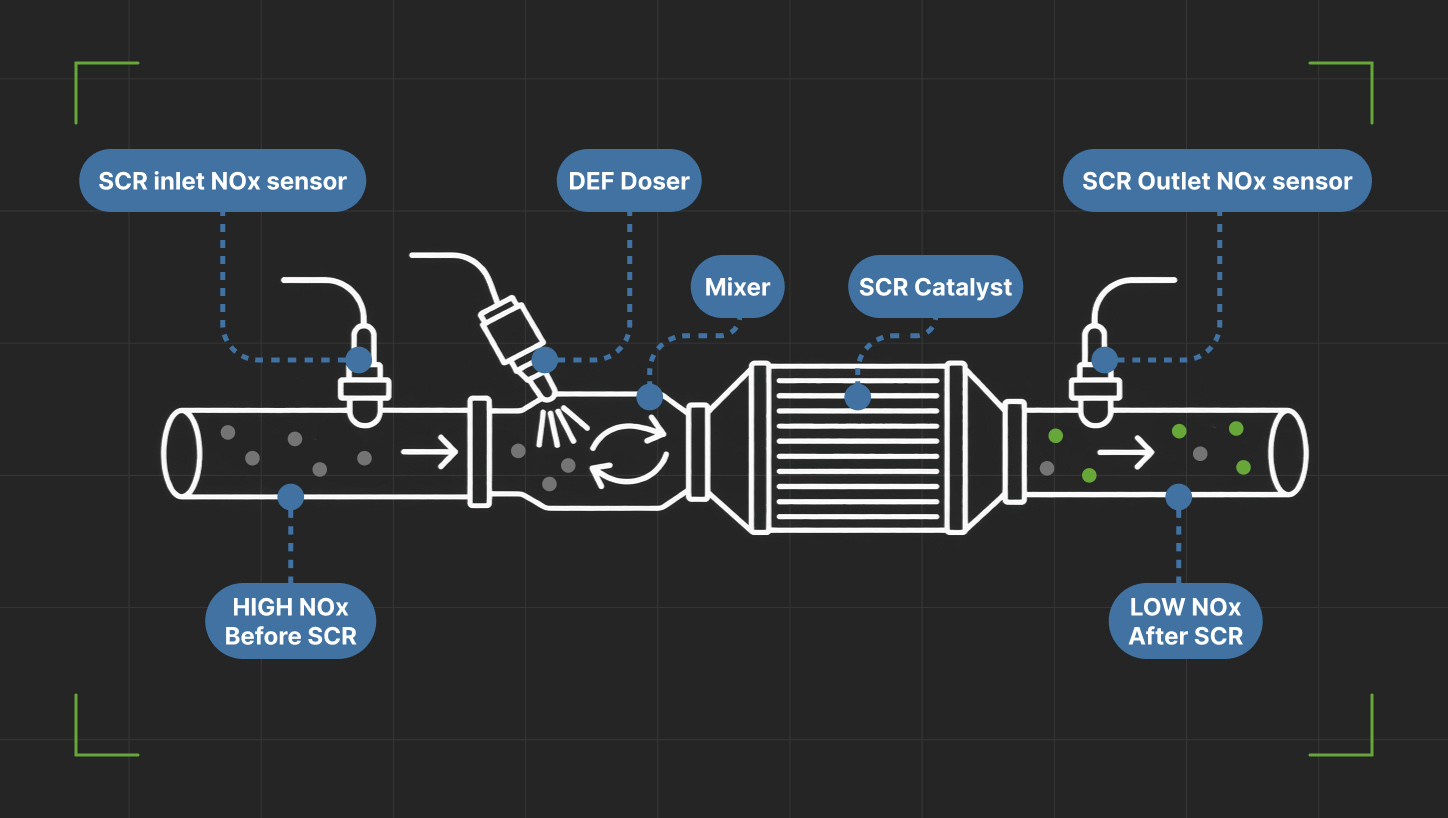
The SCR system injects DEF (Diesel Exhaust Fluid) into the exhaust so it can break down the bad nitrogen oxides into mostly just nitrogen and water. To keep an eye on how well that’s working, the computer uses NOx sensors placed both in front of and behind the SCR catalyst.
In simplified form:
Engine-out NOx → SCR inlet NOx sensor → DEF dosing → SCR catalyst → SCR outlet NOx sensor
The control module compares the upstream and downstream NOx measurements. If the measured reduction is consistently lower than expected under the required operating conditions, P20EE can be set.
Importantly, the code describes the result of the efficiency calculation, not necessarily the failed component.
A Volvo diagnostic procedure, for example, recommends checking DEF quality and dosing, followed by NOx sensor condition and function before condemning the SCR catalyst.
What Does SPN 4364 FMI 18 Mean?
On heavy-duty trucks using J1939 fault-code terminology, SPN 4364 FMI 18 indicates a condition of the low SCR conversion efficiency.
SPN 4364 corresponds to Aftertreatment 1 SCR Conversion Efficiency, while FMI 18 indicates that the parameter is valid but below the normal operating range at a moderately severe level on applicable systems.
The exact wording varies between engine manufacturers and emission generations, but the diagnostic principle is the same:
The SCR system is not demonstrating the expected reduction in NOx.
Detroit Diesel documentation, for example, describes SPN 4364 FMI 18 as low SCR NOx conversion efficiency and identifies the SCR inlet and outlet NOx sensors as the monitored parameters.
This is why SPN 4364 FMI 18 should not automatically be interpreted as “bad SCR catalyst.”
P20EE and SPN 4364 Symptoms
Depending on the truck, engine, emission level, and severity of the fault, the driver may see:
Check Engine or MIL (Malfunction Indicator Lamp) illumination
DEF or emissions-system warning
SCR efficiency warnings
Increasing aftertreatment fault activity
DEF system warnings
Engine derate
Speed limitation
P20EE / SPN 4364 FMI 18 returning after the fault is cleared
Additional codes such as P204F or other DEF/SCR-related faults
A P20EE-related derate can become particularly problematic when the underlying cause remains unresolved. Some OEM repair documentation associates SCR efficiency faults with engine derate or vehicle speed limitation.
Most Common Causes of Low SCR Efficiency
1. Faulty or Biased NOx Sensors
NOx sensors are one of the first components to check.
The SCR efficiency calculation depends on comparing NOx concentration before and after the catalyst. If either sensor is reporting an incorrect value, the control module can calculate low conversion efficiency even when the catalyst itself is capable of working correctly.
A sensor can be problematic without necessarily producing an obvious electrical fault.
Possible problems include:
Sensor drift
Incorrect NOx readings
Sensor contamination
Wiring or communication problems
Heater problems
Incorrect sensor installation
Non-OEM sensor performance issues
This is why replacing the SCR catalyst before validating the NOx sensors can result in an unnecessary and expensive repair.
2. Poor-Quality or Contaminated DEF
DEF quality directly affects SCR operation.
The DEF needs the proper urea level and has to stay free of any contamination. If the concentration is wrong, the SCR system won’t be able to hit the NOx conversion numbers it’s designed for.
Possible problems include:
Incorrect urea concentration
Contaminated DEF
Old or improperly stored DEF
Wrong fluid added to the DEF tank
DEF contamination from another substance
OEM diagnostic procedures specifically include DEF quality and concentration checks when investigating P20EE and related SCR faults.
3. DEF Doser Problems
That DEF doser (you’ll also hear it called the reductant injector) is the part that decides how much fluid actually gets pumped into the exhaust.
If the doser delivers too little DEF, the SCR catalyst may not receive enough ammonia to reduce NOx effectively.
Problems can include:
Restricted doser
Incorrect dosing quantity
Crystallization
Poor spray pattern
Doser valve malfunction
DEF pressure problems
Restricted DEF supply
Dosing control problems
Excessive dosing can also create problems. More DEF does not necessarily mean better SCR performance.
If the dosing is off, you can end up with deposits building up, ammonia slipping past the catalyst, and a bunch of other aftertreatment headaches.
4. DEF Crystallization
DEF can form deposits when it does not properly evaporate and decompose in the exhaust.
You can get crystals forming around the dosing area, the mixer, or other parts of the exhaust.
However, crystallization should be interpreted correctly. The presence of DEF deposits does not automatically prove that the doser itself is leaking or defective. Detroit Diesel diagnostic material specifically warns against making that assumption.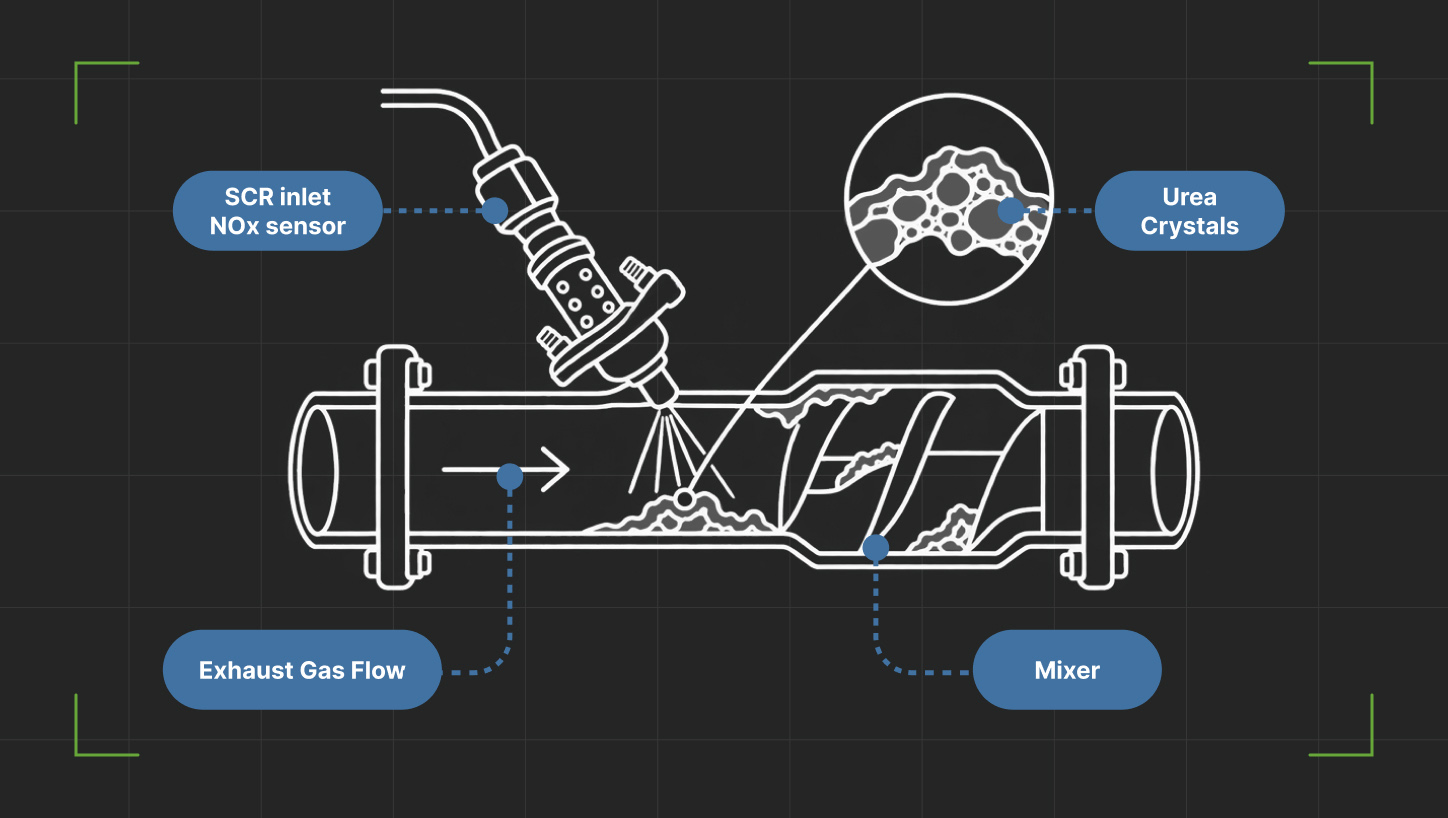 The technician should determine why the deposits formed rather than simply replacing the injector.
5. SCR Catalyst Degradation
The SCR catalyst can genuinely lose efficiency.
Possible reasons include:
High mileage
Thermal damage
Catalyst aging
Oil contamination
Coolant contamination
Chemical contamination
Incorrect exhaust temperatures
Previous engine or aftertreatment failures
A failed or degraded SCR catalyst should generally be considered after the upstream causes have been checked.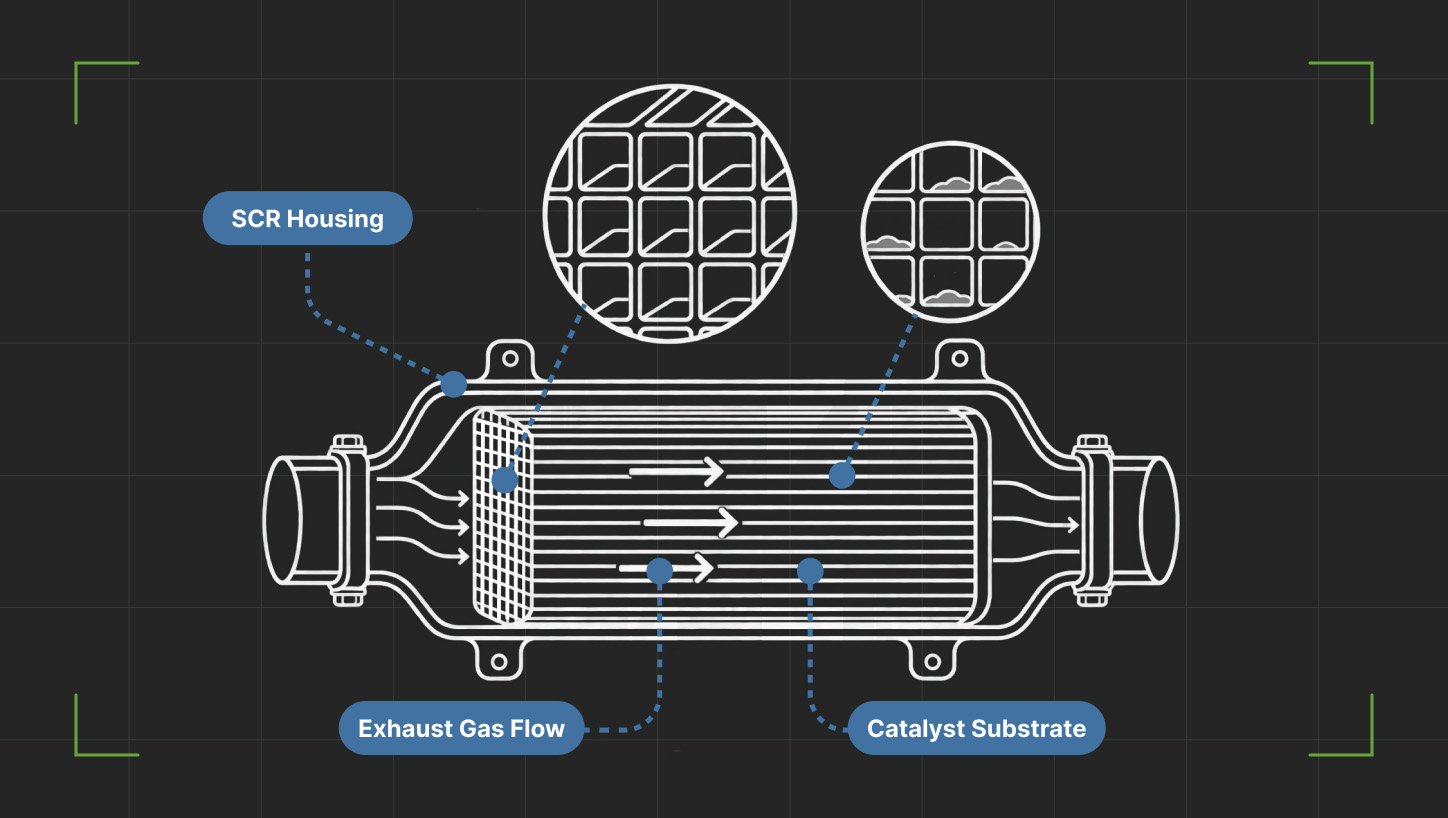 Otherwise, an expensive catalyst replacement may not solve the original problem.
6. Exhaust Temperature Problems
SCR conversion depends heavily on exhaust temperature.
If the exhaust temp stays outside the range it needs to be in, the chemical reactions inside the SCR catalyst just don’t work as well as they should.
Possible causes include:
Engine operating too cold
Faulty exhaust temperature sensors
Thermostat problems
Excessive idle operation
Incorrect regeneration behavior
Exhaust leaks
DPF problems
Incorrect engine programming
Low temperature is particularly relevant when the fault appears during low-load operation.
7. Exhaust Leaks
An exhaust leak can affect the conditions under which the SCR system operates and may also interfere with sensor measurements.
Inspect:
Exhaust joints
Clamps
Flex pipes
Sensor ports
Doser/mixer connections
SCR housing
Exhaust piping before and around the SCR system
A small leak can be easy to overlook during a visual inspection.
8. Engine-Out NOx Is Too High
SCR efficiency cannot be evaluated independently of the engine.
When the engine’s already dumping out higher-than-normal NOx levels before the exhaust reaches the SCR, the aftertreatment system can have a tough time hitting the conversion efficiency it’s supposed to.
Potential contributors include:
Air-system problems
Charge-air leaks
EGR problems
Turbocharger issues
Incorrect fuel delivery
Engine timing/programming problems
Excessive combustion temperature
Therefore, a technician should not focus exclusively on the SCR catalyst when diagnosing P20EE.
P20EE Diagnostic Procedure
A systematic diagnostic sequence is more effective than replacing components based on the fault code alone.
Step 1: Scan All Active and Stored Faults
Start with a complete diagnostic scan.
Record:
P20EE
SPN 4364 FMI 18
P204F
NOx sensor faults
DEF pressure faults
DEF dosing faults
Exhaust temperature faults
DPF-related faults
Engine performance faults
Other active faults can provide the actual cause of the SCR efficiency problem.
If another fault clearly explains abnormal NOx production, temperature, or DEF dosing, that problem should generally be addressed first.
Step 2: Check DEF Quality
Make sure the DEF actually meets the correct specification.
Check for:
Correct concentration
Contamination
Visible deposits
Incorrect fluid
Evidence of poor storage
Just because the DEF tank is full doesn’t mean the whole DEF system is working the way it should.
Step 3: Test DEF Dosing
The doser should be tested for proper operation and quantity.
Inspect the injector for:
Crystallization
Blockage
Incorrect spray pattern
Physical damage
If it applies to your setup, make sure to check the DEF supply system and line pressure, too. Most factory troubleshooting steps have you verify DEF quality and dosing performance well before you even think about condemning the SCR catalyst.
Step 4: Compare NOx Sensor Data
Compare the readings from the: SCR inlet NOx sensor and SCR outlet NOx sensor
Signals from the control module are used to calculate SCR conversion efficiency.
If the signals from the control module are unbelievable, unstable or not congruent with the operating conditions, then look into the sensors before assuming that the catalyst is bad.
Step 5: Verify Exhaust Temperatures
Check the relevant exhaust temperature sensors and live data.
The SCR catalyst must operate within its effective temperature range. A temperature problem can make a healthy catalyst appear inefficient.
Step 6: Inspect the Exhaust and SCR System
Inspect the complete aftertreatment system for:
Exhaust leaks
Damaged piping
DEF deposits
Doser problems
Damaged mixer
SCR housing damage
Catalyst contamination
Evidence of overheating
Step 7: Evaluate the SCR Catalyst
Only after DEF, dosing, NOx sensors, temperatures, exhaust integrity and other engine conditions have been checked can the SCR catalyst become the primary suspect.
This approach prevents the common mistake of treating P20EE = replace SCR catalyst.
P204F and P20EE: What Is the Difference?
P204F is generally associated with a reductant/DEF system performance problem, while P20EE specifically concerns SCR NOx catalyst efficiency.
They can appear together because DEF quality or dosing problems can cause the SCR system to fail its NOx conversion test.
For example:
DEF problem → incorrect dosing → poor SCR reaction → low NOx conversion → P20EE
Therefore, when P204F and P20EE appear together, diagnosing the DEF system becomes especially important.
Do not treat the two codes as completely independent problems.
When Is the SCR Catalyst Actually Bad?
A catalyst should not be declared defective solely because P20EE or SPN 4364 FMI 18 is present.
A more convincing catalyst diagnosis requires evidence that:
DEF quality is correct.
DEF dosing is functioning correctly.
NOx sensors provide the credible data.
Exhaust temperatures are appropriate.
The exhaust system has no relevant leaks.
Engine operation is not producing abnormal NOx.
The SCR system still fails its efficiency test.
Only then does catalyst degradation become a strong conclusion.
This diagnostic sequence is seen in OEM repair guidance as well. For example, checking DEF and NOx sensors is performed prior to SCR replacement.
P20EE Derate: Why Does the Truck Lose Power or Speed?
A persistent SCR efficiency fault can eventually activate an emissions-related derate.
The way a derate plays out varies depending on the OEM, engine model year, emissions standard, and the severity of the fault.
The control system may progressively increase the severity of the warning or limitation if the underlying SCR problem remains unresolved.
This is why clearing P20EE without fixing the cause usually provides only a temporary result.
If the monitor runs again and detects insufficient SCR conversion, the fault can return.
Software and Tuning Solutions
Not every P20EE-related problem requires replacing an expensive SCR assembly.
After the hardware has been properly diagnosed, the software side of the system should also be considered.
A programming-related solution may be relevant when:
The hardware is known to be functional.
The vehicle has undergone an approved configuration change.
A programming update is required.
The current mapping does not correctly match the installed aftertreatment configuration.
An emissions-related derate needs to be addressed as part of a lawful, application-specific programming.
For trucks and equipment operating in jurisdictions or applications where emissions-system modifications are permitted, professional ECU/ACM tuning services can be used to adapt the control software to the applicable configuration.
The correct approach is to identify the actual vehicle, engine, ACM/ECM configuration, emission level, and fault strategy before selecting a software solution.
SCR/DEF Software Service
A professional tuning service can include:
ECM/ACM diagnostic assessment
VIN and configuration identification
Fault-code analysis
Programming compatibility check
Software update or tuning correction
Restoration of the appropriate stock programming when required
Verification after programming
Software should not be used as a substitute for a defective NOx sensor, failed DEF doser, contaminated DEF, or physically damaged SCR catalyst.
For road-going vehicles, any emissions-related programming must comply with the laws and regulations applicable to the vehicle's location and intended use.
Why Guessing at P20EE Gets Expensive
P20EE is a particularly good example of why fault-code diagnosis should follow the system rather than the code name.
The same fault can originate from:
NOx sensor → DEF → doser → temperature → exhaust → engine → SCR catalyst → Programming
Replacing the SCR catalyst immediately may solve the problem if the catalyst is actually degraded. But if the real problem is a biased NOx sensor or incorrect DEF dosing, the new catalyst may eventually produce exactly the same P20EE fault.
A structured diagnostic process can therefore save both parts cost and downtime.
P20EE and SPN 4364 Diagnostic Checklist
Before replacing major aftertreatment components, verify:
All active and stored DTCs
P20EE status and occurrence history
SPN 4364 FMI 18 status
DEF quality
DEF contamination
DEF pressure
DEF doser operation
Doser spray pattern
DEF crystallization
SCR inlet NOx sensor
SCR outlet NOx sensor
NOx sensor plausibility
Exhaust temperature readings
Exhaust leaks
DPF condition
Engine-out NOx-related problems
SCR catalyst condition
ECM/ACM programming and configuration
Final Takeaway
P20EE and SPN 4364 FMI 18 mean that the SCR system is not achieving the expected NOx conversion efficiency. They do not, by themselves, prove that the SCR catalyst has failed.
The most effective diagnostic strategy is to start with the information the SCR system uses to calculate efficiency: NOx sensor data, DEF quality, DEF dosing, exhaust temperature, and system integrity.
If these areas pass inspection, the SCR catalyst itself becomes a much stronger suspect.
For vehicles where a software solution is legally applicable, ECM/ACM tuning can then be evaluated alongside the hardware diagnosis. This is particularly relevant when an incorrect configuration, programming issue, or permitted application-specific modification is responsible for persistent SCR faults or an associated derate.
FAQ
What does P20EE mean on a diesel truck?
P20EE means SCR NOx Catalyst Efficiency Below Threshold. The control system has determined that the SCR system is not reducing NOx sufficiently under the conditions used for the efficiency monitor. It does not automatically mean that the SCR catalyst needs to be replaced.
What does SPN 4364 FMI 18 mean?
SPN 4364 FMI 18 indicates low SCR conversion efficiency. The system has detected that the calculated SCR NOx conversion is below the expected operating range. On applicable heavy-duty systems, the calculation relies on NOx measurements before and after the SCR catalyst.
Can a bad NOx sensor cause P20EE?
Yes. Since SCR efficiency is calculated using NOx sensor data, an inlet or outlet NOx sensor providing inaccurate data would cause the system to report low SCR efficiency, when in fact the catalyst is working properly.
Can bad DEF cause P20EE?
Yes. Using the wrong DEF or poor DEF quality and/or concentration can cause DEF contamination. Contaminated DEF can prevent the SCR system from achieving NOx conversion. During a normal operation of the SCR system, the DEF tank should be checked for contamination. DEF quality and dosing should be checked prior to replacing the SCR catalyst.
What is the connection between P204F and P20EE?
P204F is typically a general performance issue with the DEF/reductant system, while P20EE zeros in on the SCR not converting NOx the way it should. They can appear together when a DEF quality or dosing problem causes the SCR system to fail its efficiency test.
Can a DEF doser cause SPN 4364 FMI 18?
Yes. If the doser isn’t working right, it can squirt out either too little or too much DEF — and either way, the SCR catalyst won’t be able to do its job properly. A restricted or crystallized doser should be inspected and tested before condemning the SCR catalyst.
Does P20EE always mean the SCR catalyst is bad?
No. P20EE is an efficiency result, not a direct component-failure code. NOx sensors, DEF, dosing, temperature, exhaust leaks, engine operation, and other aftertreatment components should be evaluated first.
Can P20EE cause a truck to go into derate?
Yes. Depending on the engine and the emissions setup, a stubborn SCR efficiency code can put the truck into an emissions derate or limit the speed. Exactly how that plays out depends on the manufacturer and which emissions standard the engine was built to.
Can software tuning remove P20EE or an SCR derate?
A software solution may be appropriate for certain lawful, application-specific configurations, but it should not be used to conceal a defective component on a vehicle that is required to comply with emissions regulations. The correct solution depends on the vehicle, engine, ACM/ECM configuration, applicable emissions requirements, and the actual cause of the fault.