



Why won't my truck regen when I start a parked or forced regeneration?
A truck may deny regeneration because an active DTC (Diagnostic Trouble Code) is blocking the process, the calculated soot load is too high, required temperature conditions are not met, or a sensor, DPF, EGR, fuel-dosing, or engine problem prevents the ECM from safely starting regeneration.
What should I do if my truck asks for regen but won't regen?
Start by reading the active diagnostic codes and checking the regeneration status. Do not repeatedly force regeneration before identifying the reason it was denied. A truck that asks for regen but won't regen can eventually enter a derate condition if the underlying problem is not corrected.
Truck Won't Regen: What Does It Mean?
When a truck displays a DPF regeneration required message but refuses to start a parked or forced regeneration, the problem is usually not the regeneration command itself.
The ECM is making a decision based on multiple inputs.
If one of the required conditions is not satisfied, regeneration can be:
Denied before it starts
Inhibited by an active fault
Interrupted after starting
Unavailable because the soot load is too high
Stopped because the system cannot achieve the required temperature
Blocked because another engine or aftertreatment fault must be repaired first
This is why the correct diagnostic question is not simply: “How do I force a regen?”
It is: “What condition is preventing the ECM from allowing regeneration?”
IMPORTANT: If your truck won't regen and the DPF warning is accompanied by a derate, do not continue repeatedly commanding forced regeneration without reading the active DTCs. The truck may be protecting the engine or aftertreatment system from a condition that regeneration cannot fix.
1. Parked Regen Won't Start: Check the Blocking Conditions First
A parked regen won't start situation can be caused by something as simple as an unmet operating condition or as serious as excessive DPF soot loading.
Before replacing the DPF, check whether the ECM is actually allowing regeneration.
Typical requirements can include:в
Engine at the required operating temperature
Vehicle stationary
Parking brake applied
Transmission in the required position
Accelerator released
No active regeneration-inhibiting faults
Soot level within the permitted range
Adequate fuel level where required
Correct aftertreatment sensor readings
Correct exhaust temperature conditions
The exact criteria depend on the truck manufacturer, engine and aftertreatment configuration.
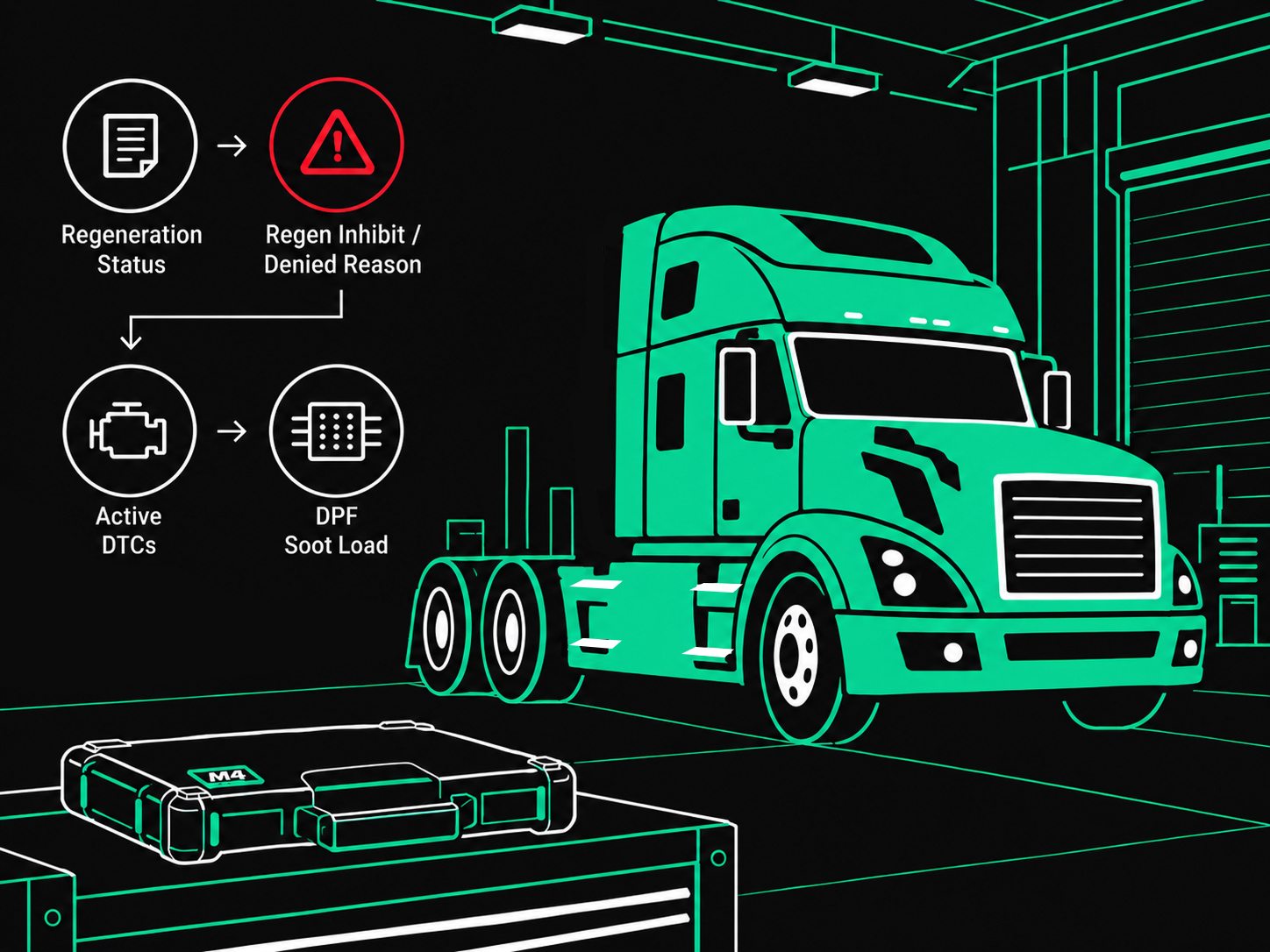
The first diagnostic question
If the truck refuses a parked regen, connect a compatible diagnostic tool and look for:
Regeneration status → Regen inhibit/denied reason → Active DTCs → DPF soot load
This can often tell you much more than simply pressing the regen button again.
2. Free DTC Check: Find Out Why Regen Is Denied
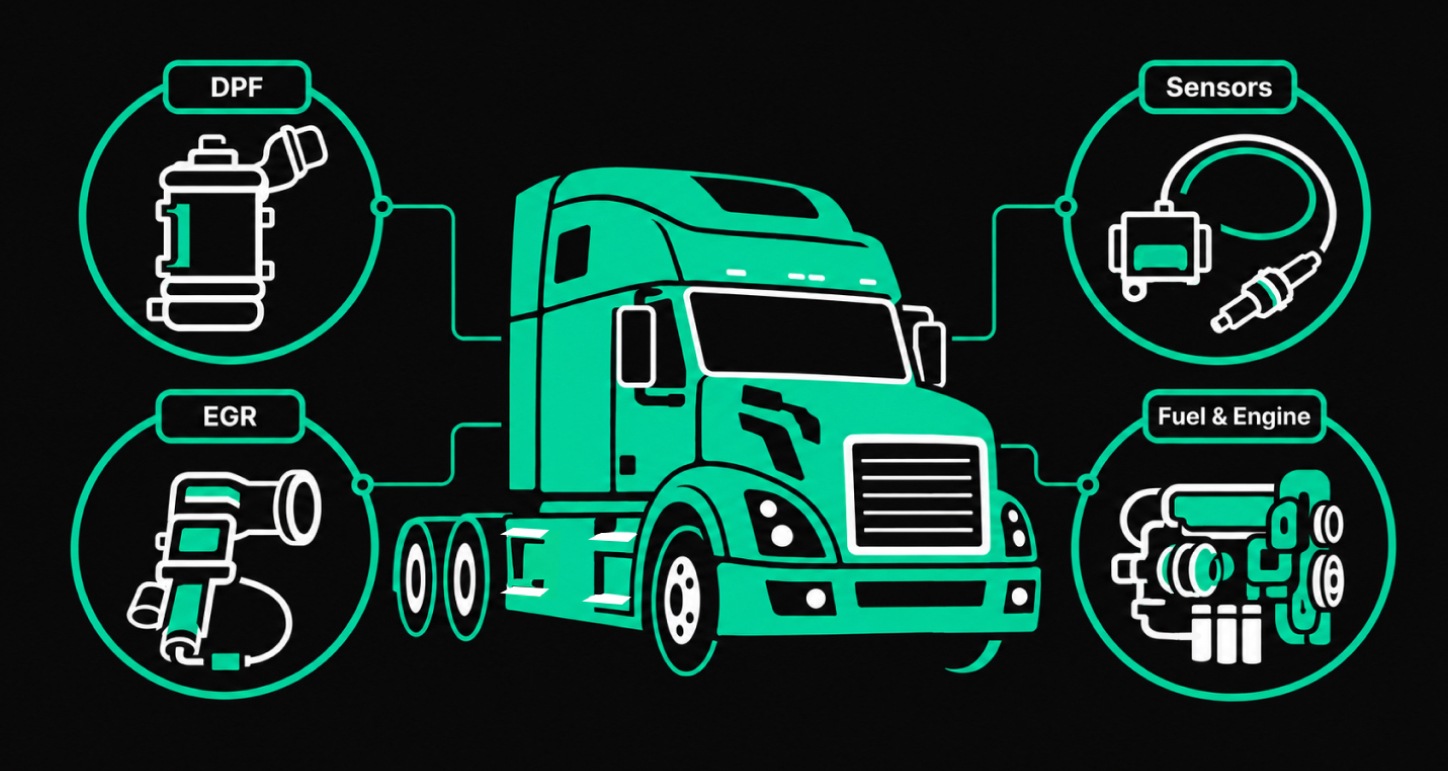
When a customer reports a truck won't regen, the fastest first step is often a diagnostic scan.
A basic DTC read can identify whether the ECM or aftertreatment controller is actively preventing regeneration.
Look for faults related to:
DPF
Excessive soot accumulation
Excessive differential pressure
DPF restriction
Regeneration frequency
Regeneration temperature
Regeneration time
Soot-load calculation
EGR
EGR flow problems
EGR valve position
EGR temperature
EGR differential pressure
EGR control faults
Sensors
Pay particular attention to:
Exhaust gas temperature sensors
DPF differential-pressure sensor
NOx sensors
Intake pressure sensors
Boost pressure sensors
Exhaust pressure sensors
Fuel and engine systems
Also check:
Injector faults
Fuel pressure
Aftertreatment fuel dosing
Turbocharger faults
Boost control
Engine temperature
Air-management faults
A DPF-related warning does not necessarily mean that the DPF is the original problem.
3. DPF Regen Failed Because the Soot Load Is Too High
One of the most serious situations is a high soot load.
The ECM estimates how much particulate matter has accumulated in the DPF. That calculation can involve differential pressure, operating conditions, regeneration history and other parameters.
When the calculated soot level becomes excessive, the truck may stop allowing a normal parked regeneration.
This creates a common sequence:
DPF warning → regen request → regen denied → soot increases → derate → forced regen unavailable
At this point, repeatedly requesting regeneration is unlikely to solve the underlying problem.
What does “DPF full” actually mean?
A dashboard message such as DPF full or DPF soot level high does not automatically mean that the filter physically needs to be replaced.
It means the aftertreatment system believes the particulate loading has reached a level requiring attention.
This step answers the following:
Is the soot calculation accurate?
Is the DPF differential pressure plausible?
Are the temperature sensors working correctly?
Can the system generate regeneration temperature?
Is fuel dosing working?
Is the engine producing excessive soot?
Is the DPF restricted by soot, ash or physical damage?
Only after those questions are answered can you determine whether the DPF itself needs service.
4. Forced Regen Not Working
A forced regen not working situation is different from simply having a driver unable to initiate a parked regeneration.
A diagnostic tool may send the regeneration command, but the ECM can still reject it.
Why?
Because a forced regeneration command will only partially override the ECM's safety and operating logic.
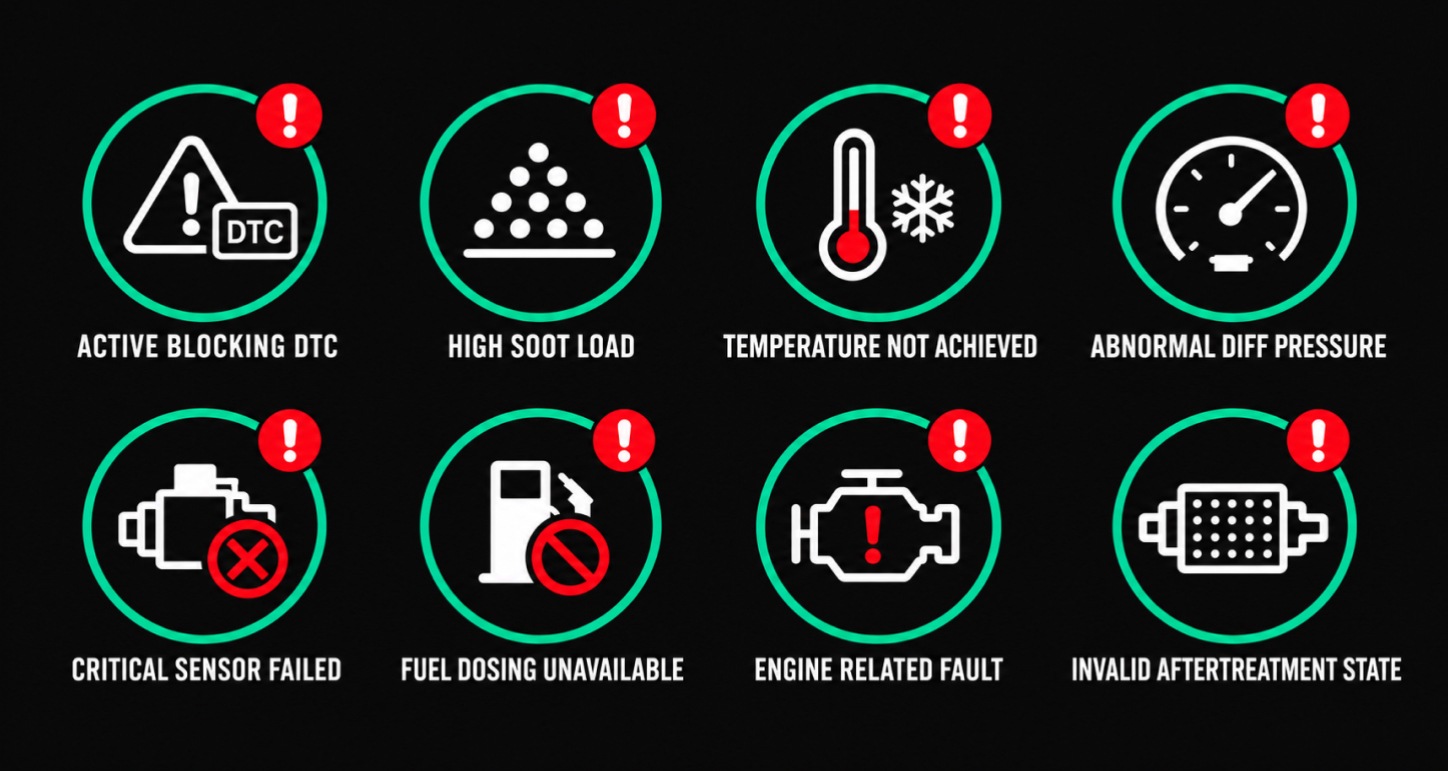
The controller may still refuse regeneration when:
An active blocking DTC is present
Soot loading is beyond the permitted limit
Temperature conditions cannot be achieved
Differential-pressure readings are abnormal
A critical sensor has failed
Fuel dosing is unavailable
The engine has a related fault
The aftertreatment system is not in a valid state for regeneration
Therefore:
Forced regen is a diagnostic function, not a substitute for repairing the reason regeneration was denied.
5. Regen Starts but Then Stops
Sometimes the truck does begin regeneration.
The engine speed changes, exhaust temperatures increase and the regen appears to be working.
Then it stops.
This is a DPF regen failed condition that requires a slightly different approach.
Common causes
Exhaust temperature is too low
The system may not be able to maintain the required temperature because of:
Faulty EGT sensor
Exhaust leak
Fuel-dosing problem
Turbocharger or air-management issues
Engine operating condition
Differential pressure is abnormal
A faulty pressure sensor or blocked pressure line can cause the ECM to interpret DPF restriction incorrectly.
Check both the sensor and the physical pressure lines.
Fuel dosing is not working
Many modern aftertreatment systems require additional fuel to generate the heat necessary for regeneration.
If the dosing system does not operate correctly, the ECM may terminate regeneration.
Another engine fault appears
Soot production rates can increase due to engine issues causing exhaust changes, resulting in an interruption of the regeneration process.
This becomes important when there are DPF and EGR-related faults occurring simultaneously.
6. EGR Problems Can Prevent Successful Regeneration
Air management for the engine, along with the DPF and EGR systems, helps dictate the makeup of the exhaust gas and the particles that are produced from combustion.
An EGR problem can contribute to:
Increased soot production
Abnormal combustion
Incorrect exhaust temperatures
Poor regeneration performance
Frequent regeneration
DPF loading
Therefore, when a truck won't regen, do not automatically focus exclusively on the DPF.
Check the EGR system and related engine parameters as well.
A useful diagnostic pattern
If you see:
EGR fault → increased soot → DPF warning → regen request → regen denied
then replacing the DPF without correcting the EGR problem may simply result in the same failure returning.
7. Bad Sensors Can Make a Good DPF Look Bad
Modern aftertreatment systems depend heavily on sensor feedback.
A sensor does not have to be completely dead to cause regeneration problems.
An incorrect but plausible reading can also cause trouble.
For example, a differential-pressure sensor that reports excessive pressure may make the ECM believe that the DPF is more restricted than it actually is.
Similarly, an incorrect exhaust temperature reading can prevent the ECM from determining that the required regeneration conditions have been achieved.
Check the data, not just the DTC
A diagnostic code tells you that the ECM detected a problem.
Live data helps determine what the system is actually seeing.
Before replacing components, compare:
EGT sensor values
DPF differential pressure
Engine coolant temperature
Intake/boost pressure
Calculated soot load
Regeneration temperature
Regeneration state
Dosing command and response
DID YOU KNOW?
A regeneration can be denied even when the DPF itself is physically capable of being regenerated. The ECM may block the process because another component cannot provide reliable information or because another fault could make regeneration unsafe or ineffective.
8. Truck Derate No Regen: Why the Situation Gets Worse
One of the most urgent combinations is:
DPF full + regen denied + truck derate
At this stage, the truck may already have entered a protection strategy.
The purpose of the derate is to prevent continued operation under conditions that could damage the engine or aftertreatment system.
Depending on the truck and fault, the driver may experience:
Reduced engine power
Reduced vehicle speed
Regeneration unavailable
Increasing DPF restriction
Additional warning messages
A more severe derate after continued operation
This is why a truck derate no regen condition should be diagnosed as soon as possible.
The longer the truck operates with excessive soot loading, the more difficult the situation can become.
9. What to Check Before Replacing the DPF
DPF is expensive. Replacing the filter can quickly be a waste of money if the reason for the regeneration failure isn’t fixed beforehand.
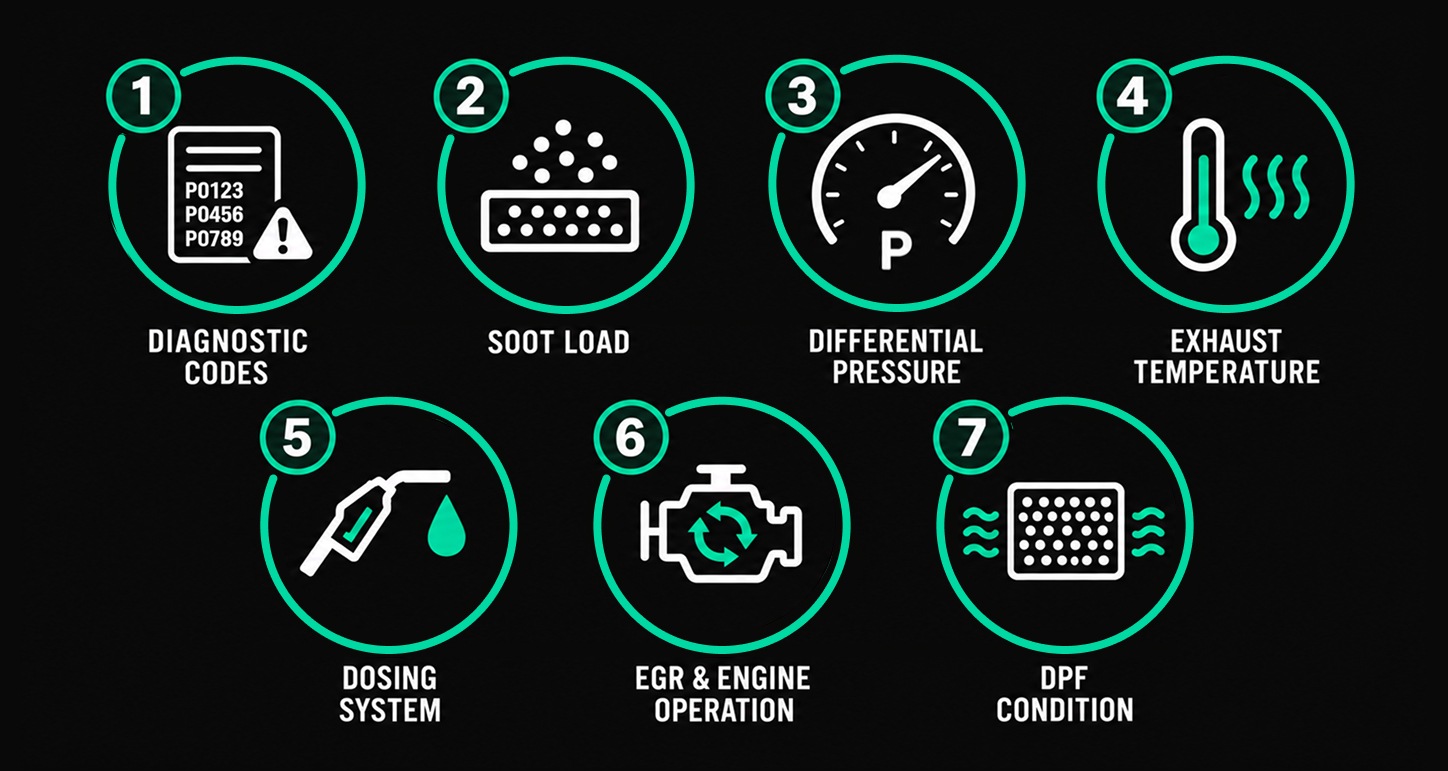
Before replacing the DPF, check:
Diagnostic codes
Read all relevant ECM and aftertreatment DTCs.
Soot load
Determine the calculated soot level and whether it is within the range where normal or service regeneration is permitted.
Differential pressure
Check DPF pressure at:
Idle
Increased engine speed
Under load where appropriate
Exhaust temperature
Confirm that temperature sensors display valid readings and that the system is able to heat up to the regeneration temperature.
Dosing system
Confirm that the aftertreatment fuel-dosing system operates correctly.
EGR and engine operation
Check for faults that could cause excessive particulate production.
DPF condition
If the electronic data indicates genuine restriction, determine whether the filter contains:
Excessive soot
Excessive ash
Physical damage
Melted or cracked substrate
10. When a Regen Is Not the Right Repair
There are situations where the correct solution is not another regeneration.
For example:
Excessive ash
Ash accumulation cannot simply be burned away through normal regeneration.
Physical DPF damage
A cracked or melted filter cannot be repaired by regeneration.
Severe restriction
A severely restricted DPF may require professional cleaning or replacement.
Engine producing excessive soot
A new DPF will quickly become loaded again if an injector, turbocharger, EGR or air-management problem remains unresolved.
Emissions-system fault
If the aftertreatment system has a hardware or control problem, regeneration may only temporarily hide the symptom.
11. DPF/EGR Tuning: When Is It Relevant?
For certain applications, particularly off-road, competition, export, agricultural or other applications where emissions-system modification is permitted, software programming may be an alternative to repairing a failed emissions system.
A DPF/EGR tuning solution can involve modifying the engine control strategy so that the ECM no longer attempts to perform functions associated with removed or modified emissions hardware.
However, this is application- and jurisdiction-dependent.
For an on-road vehicle subject to emissions regulations, disabling or removing emissions controls may be illegal and can result in inspection, registration, warranty or enforcement problems.
The correct approach is therefore to determine first:
What is the vehicle used for, what hardware is installed, and what emissions requirements apply to that application?
If the application legally permits emissions-system modification, the appropriate programming can be determined after identifying the exact engine, ECM, software version and aftertreatment configuration.
IMPORTANT: Do not use tuning to hide an unresolved mechanical problem. If the truck is producing excessive soot because of an injector, turbocharger, EGR or engine fault, programming changes do not repair the underlying mechanical issue.
12. Truck Won't Regen: Quick Diagnostic Workflow
When the truck is urgently asking for regeneration, use this sequence:
Step 1 — Read the DTCs
Do not start with a forced regeneration.
Step 2 — Identify the regen status
Determine whether regeneration is:
Available
Requested
Active
Inhibited
Denied
Aborted
Step 3 — Check soot load
Determine if the DPF is within the regeneration range permitted by EPA.
Step 4 — Check pressure and temperature
Verify the differential pressure accuracy and the exhaust temperature measurements.
Step 5 — Check EGR and engine faults
Find conditions favorable for soot production and poor regeneration.
Step 6 — Check dosing
Check that the aftertreatment fuel-dosing system can reach the necessary temperature.
Step 7 — Decide whether regeneration is appropriate
If the system is healthy and soot loading is within the permitted range, perform the appropriate regeneration procedure.
If the system is blocked, repair the condition first.
Step 8 — Evaluate the DPF
If restriction remains excessive after correcting the underlying problem, inspect, clean or replace the DPF as appropriate.
The Bottom Line
When a truck won't regen, the regeneration button is rarely the real problem.
A parked regen won't start because the ECM has determined that one or more required conditions are not satisfied. A forced regen not working situation usually means the underlying blocking condition still exists. And when the truck reaches high soot load or truck derate no regen, continuing to command regeneration can make the situation more difficult rather than fixing it.
The fastest path is:
Read DTCs → identify the regen denial reason → check soot, pressure and temperature → inspect EGR/engine/dosing → determine whether the DPF actually needs service.
For applications where emissions-system modification is legally permitted, a DPF/EGR tuning solution may be considered after the vehicle configuration and intended use have been established.
FAQ
Why won't my truck regen?
The most common reasons are active blocking DTCs, excessive soot loading, insufficient exhaust temperature, sensor faults, fuel-dosing problems, EGR/engine faults or excessive DPF restriction.
Why won't my parked regen start?
The ECM may be denying regeneration because the required operating conditions have not been met or because an active fault is preventing the process.
What does “regen denied” mean?
It means the ECM has determined that regeneration cannot currently be performed under the existing conditions.
Can I force a DPF regen if the truck refuses?
A diagnostic tool may provide a forced-regeneration function, but the ECM can still reject the request when critical conditions or faults are present.
What does DPF full mean?
It generally means the ECM has calculated that the DPF has reached a high particulate loading. The exact severity depends on the truck's system and calculated soot level.
Why does my truck ask for regen but won't regen?
The truck can request regeneration while simultaneously being unable to perform it. This commonly occurs when a blocking DTC, excessive soot level, sensor problem or temperature/dosing issue prevents the regeneration criteria from being satisfied.
Can EGR problems cause DPF regen problems?
Yes, problems related to engine air management including EGR can produce an increase in soot or change exhaust conditions that can result in frequent or failed regenerations.
Should I replace the DPF after a failed regen?
Not automatically. First determine whether the failure is caused by the DPF itself or by another component or condition.
What should I do if the truck is in derate and won't regen?
Read the active DTCs immediately and determine why regeneration is being denied. A severe soot-load or aftertreatment fault may require service intervention rather than another forced regeneration attempt.